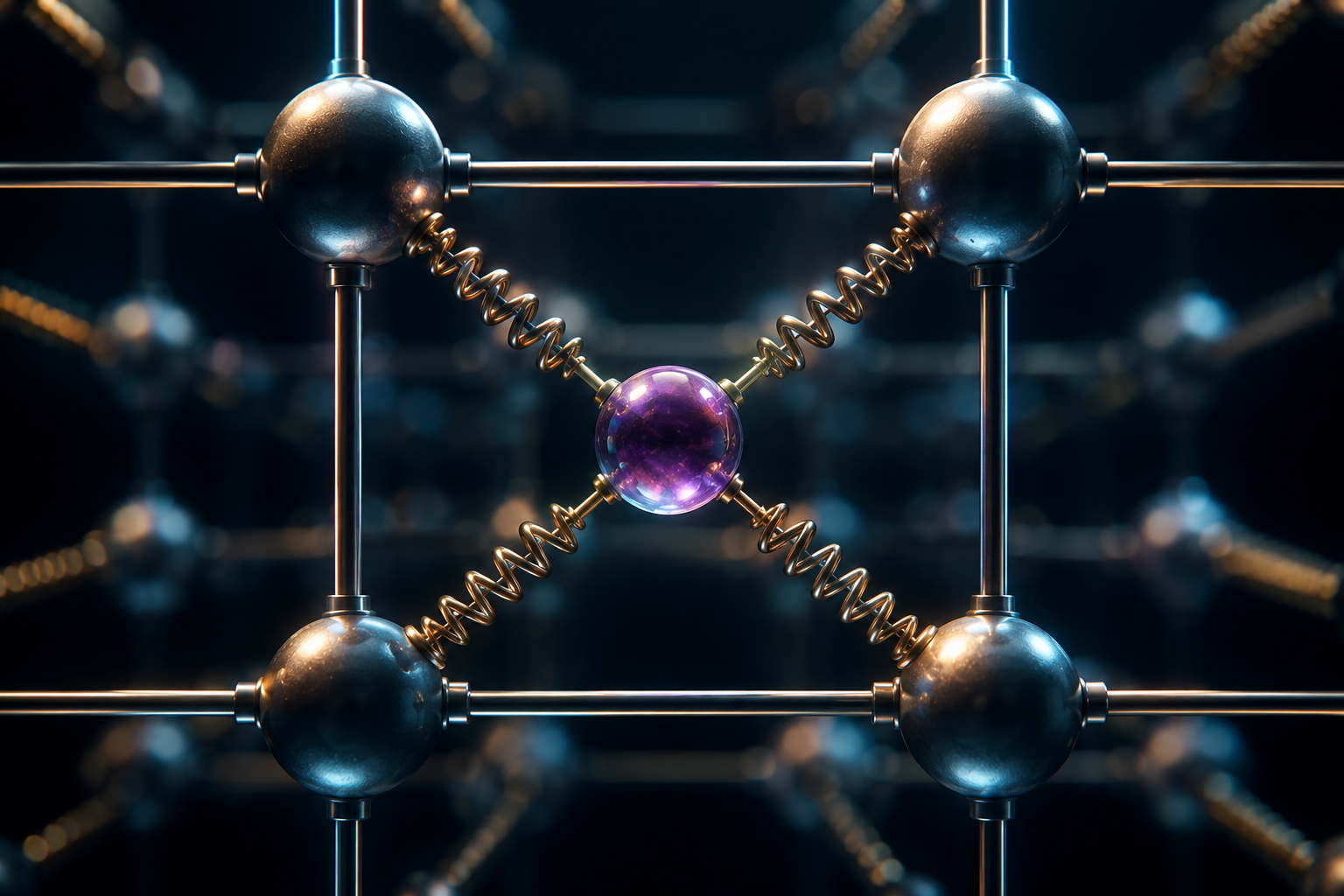
James Clerk Maxwell suggested that microscopic control of individual molecules could, hypothetically, make thermal energy available for useful work in a way that appears to contradict the second law of thermodynamics. The second law of thermodynamics effectively states that one can only harness energy through the motion of heat from hot to cold. I agree with Maxwell.
This document proposes that direct heat to electricity MAY be possible; I am not conclusively stating that it is possible. I've seen some mathematical arguments against my Invention that I myself suspect may be correct.
The context
A Brownian ratchet is a hypothetical device that some have argued might be able to convert heat to electricity in a manner contrary to the second law of thermodynamics. Others have argued that a Brownian ratchet is not capable of producing electricity. Maxwell's argument requires a measuring, calculating device to harness energy at the atomic scale. A Brownian ratchet would also be quite difficult to manufacture and would require deft atomic-scale manufacturing capabilities.
The gate
My Invention is far simpler than a measuring, calculating device or a Brownian ratchet. I have published my Invention to the public domain. My Invention is nothing more than a 'gate' that is partly open with hinge(s) that are flexible bonds. Electrons moving in one direction would tend to push the gate open and pass through. Electrons moving in the other direction would tend to close the gate and reflect. Crystals containing many cells would contain many gates.
That 'gate' exists in some crystals that are currently produced. I have downloaded the COD CIF database, which contains ~500,000 definitions of molecules. I have been filtering from COD. I have been generating simulation code, and those simulations indicate that some crystals should produce power, but there is no simulation that can be guaranteed to be 100% accurate.
Note that consistent polarity in one direction is essential; all of the gates should be pointed in the same direction.
More detailed description of the Invention
This describes a cubic crystal for simplicity; many other forms of crystal might also function.
According to the second law of thermodynamics, it is not possible to convert heat directly into electricity. However, according to James Clerk Maxwell, it is. As Maxwell defined some of the most important laws in electromagnetism, his opinion is highly respected.
While "Maxwell's demon" has nothing to do with actual demons, Maxwell indicated that direct heat-to-electricity devices may indeed be possible.
Consider a cubic crystal lattice. Consider four corner atoms that are part of that lattice arranged into a square lying in a single plane. Now, consider that a fifth "gate" atom resides close to the center of those four corner atoms. In its natural resting place, the gate atom is positioned slightly out of the plane of the four corner atoms, but is otherwise perfectly centered relative to them. Suppose this gate atom is ionically negative and is attached to the four corner atoms with flexible bonds.
An electron in motion due to heat would tend to close the gate when approaching from one direction by pushing the gate atom toward the plane of the corner atoms. With the gate atom flush in the plane of the corner atoms, there would not be enough room for the electron to slip between them. Conversely, an electron in motion due to heat approaching from the opposite direction would tend to open the gate by pushing the gate atom even further from the plane of the four corner atoms. When the electron opens the gate, it can more easily slip past.
There can be a plane of atoms within a crystal. The gate atoms will be slightly out of that plane. That form of plane can provide a natural barrier that can ensure that electrons will migrate in the direction preferred by the gate atoms. Once an electron has migrated past that barrier, there will be no way for it to migrate in the wrong direction without crossing that barrier. A small voltage increase will occur at every barrier. This should produce a steady voltage increase across many barriers.
Because the voltage increase at any one barrier is never large, there is never a large local voltage that would tend to strongly push electrons in the wrong direction. Without barriers, the voltage would tend to quickly push electrons backwards from the preferred direction once any amount of significant voltage has been created.
Rectangular and parallelogram shapes are just as valuable as a square.
100% efficiency is not expected. Sometimes electrons are going to travel in the wrong direction or fail to travel in the right direction. So long as more electrons move in the preferred direction, current will be produced.
There is a large mass difference between the electron and the gate atom. So the change in velocity and position of the electron is much larger than the change in position of the gate atom. This situation leads to the electron largely being reflected or passing through with very little movement of the gate. Although this situation would appear to prevent useful operation, the enormous number of gates in a crystal overcomes this problem in calculations.
An appropriate amount of damping of the gate atoms' motions could prevent oscillations that could prevent operation. The device would function best if the gate atom typically settled to its natural resting place between collisions. A limited number of electrons within the crystal would also allow the gate to settle most of the time between collisions. Too few electrons would reduce power production.
Heat should power this device by allowing more electrons to travel through open gates than closed ones, as electrons will tend to slip past open gate atoms but be repulsed by closed ones. A real crystal lattice would contain an enormous number of these gates, and the random motion of the electrons themselves would open and close them throughout the structure. The result should be the production of a directional electrical current given the right form of crystal.